
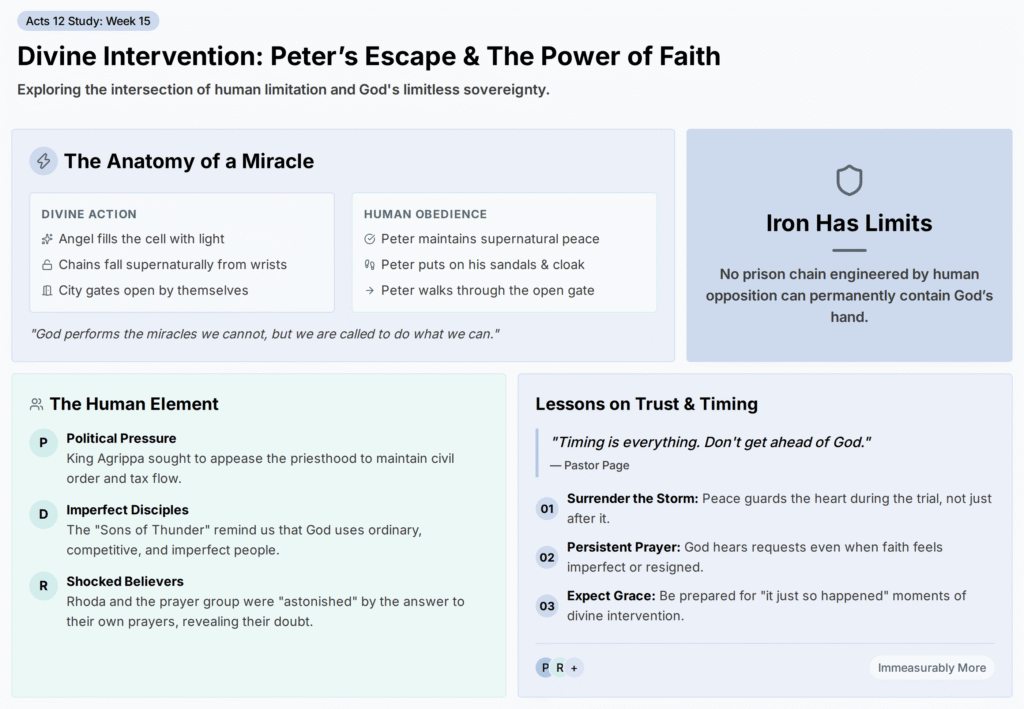
This sermon by Pastor Page explores the biblical account of Peter’s miraculous escape from prison in Acts 12, using it to illustrate the power of faith and divine intervention in seemingly hopeless situations. The pastor contrasts human limitations and anxieties with God’s limitless power, urging believers to maintain peace, perform the actions within their control, and trust in God’s timing and plan, even when it defies understanding.
The Historical Context of Peter’s Imprisonment
Pastor Page sets the stage for the sermon by providing the historical background for the events in Acts chapter 12, now in the fifteenth week of their study. He explains that King Agrippa’s actions were driven by political motivations, primarily the need to appease the Jewish leadership and priesthood, whose main role was to maintain peace and ensure taxes were paid. The pastor suggests that the priesthood likely influenced Agrippa, warning him that the growing Christian movement was getting out of control. This pressure led Agrippa to have James, the brother of John, executed by the sword and to imprison Peter.
To humanize the narrative, the pastor offers a character sketch of James and John, noting they were known as the “sons of thunder” due to their dramatic, competitive, and sometimes combative nature. He uses this to illustrate that the early disciples were ordinary, imperfect people, not “magical or magnificent.” This serves as a reminder for the congregation to extend grace to one another, acknowledging that everyone is “people being people” and that perfection is found only in Jesus.
Peter’s Peace and Miraculous Escape
The core of the sermon focuses on Peter’s remarkable state of peace on the eve of his expected execution. Despite being chained between two soldiers with multiple guards posted, Peter was soundly sleeping. The pastor contrasts this supernatural calm with the seemingly insurmountable human impossibility of his situation, drawing a parallel to Jesus sleeping in the boat during a raging storm. This peace, the pastor explains, comes not from knowing what God will do, but from knowing who God is.
The narrative of the escape highlights the division of responsibilities between divine action and human obedience. An angel appeared, filling the cell with light, and supernaturally caused the chains to fall from Peter’s wrists. However, the angel then instructed Peter to perform a series of practical tasks: “Put on your clothes and sandals,” “wrap up your cloak,” and “follow me.” The iron gate to the city opened by itself, but Peter had to walk through it. This illustrates that while God performs the miracles we cannot, we are still called to do what we can—to get ready and follow His lead. Quoting Philippians 4:6-7, Pastor Page emphasizes that true peace guards our hearts and minds right in the middle of the storm, not just after it has passed.
The Believers’ Astonishment and Imperfect Faith
The focus then shifts to the community of believers who were gathered at the house of Mary, earnestly praying for Peter’s deliverance. The pastor highlights the humorous irony of their reaction to God’s answer. When the servant girl, Rhoda, recognized Peter’s voice at the door, she was so overjoyed that she forgot to let him in and ran to tell the others. Their immediate response was not praise, but disbelief: “You’re out of your mind.” When she insisted, they rationalized it must be his angel. It was only when they opened the door themselves that they were “amazed” and “astonished.”
The pastor uses this account to encourage the congregation, pointing out that God answered the prayers of these believers despite their imperfect faith and doubt. He reassures listeners that it is common to pray for a long time without seeing results and to feel a sense of doubt or resignation. He exhorts them to never stop making their requests known to God, because He hears, sees, and has a plan, even when human understanding falls short. Their astonishment serves as a powerful reminder that God’s actions often surpass our limited expectations.
Lessons on Trust, Timing, and Divine Sovereignty
In the concluding section, Pastor Page synthesizes the key theological lessons from the narrative. He stresses the importance of God’s timing, advising, “Timing is everything. Don’t get ahead of God.” He notes that divine deliverance often waits until all human options are exhausted, urging the congregation to “be surprised by grace.” When we surrender a situation to God, we should not be surprised to witness a series of “it just so happened” moments that are clear evidence of His intervention.
The pastor powerfully declares, “Iron has limits. No prison chain or gate, engineered by human opposition, can permanently contain the movement of God’s hand.” The sermon concludes with a reference to the letter to the Ephesians, reminding everyone that God is able to do “immeasurably more than we can ever ask or imagine.” The ultimate source of peace is trusting in God’s sovereign plan and His ever-present nature, knowing He has a plan “not to harm you, but to give you hope and a future.”