
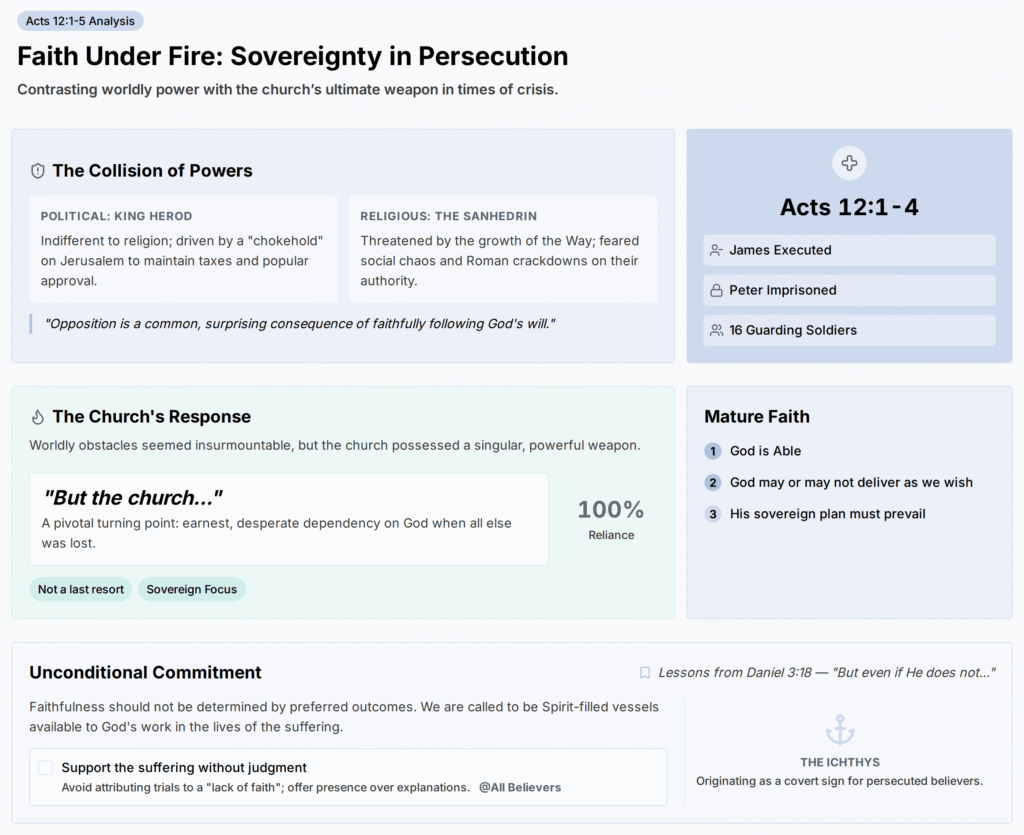
This sermon analyzes Acts chapter 12, verses 1-5, establishing a theological framework for understanding persecution and faith. It examines the political and religious dynamics leading to the death of James and the imprisonment of Peter, contrasting the world’s power (Herod, Sanhedrin) with the church’s ultimate weapon: earnest prayer, and setting the stage for God’s sovereign response.
The Inevitability of Opposition in Christian Life
The sermon begins by framing the Christian journey as a natural cycle of “ups and downs,” with periods of joy inevitably followed by difficult times. The narrative of the Book of Acts exemplifies this, pivoting from the success and celebration of the church’s establishment in Antioch (Acts 11) to the sudden, intense persecution in Jerusalem (Acts 12). This quick turn serves as a real-life example of how believers can trace the hand of God through life’s unpredictable shifts. The pastor emphasizes that opposition is a common, and often surprising, consequence of faithfully following God’s will. Rather than expecting accolades or public approval for doing the right thing, believers should be prepared for pushback, as those who take a righteous stand will often face more opposition than support. The sermon warns against seeking popular opinion as a motivation, citing King Herod as a cautionary tale of a leader who let public approval guide his actions with disastrous results.
The Collision of Political and Religious Powers
The persecution detailed in Acts 12 arose from a complex and volatile socio-political landscape in first-century Jerusalem. The pastor identifies the conflicting motivations of three key groups whose interests collided to create an oppressive environment for the early church. First, the Jewish religious leaders (the Sanhedrin and Sadducees) felt their authority and influence were threatened by the growing Christian movement, which they had opposed since the time of Jesus. They feared that the movement could cause social chaos, which would in turn invite a stricter crackdown from their Roman overseers. Second, the Roman ruler, King Herod, held a “chokehold” on Jerusalem, permitting the Jewish leaders to manage their own affairs on two conditions: they must maintain peace and ensure taxes were paid. As a pagan ruler, Herod was indifferent to their religious disputes, but he was keenly interested in maintaining control and revenue. This dynamic created a scenario where religious authority and political will converged to oppress the innocent. Finally, the sermon clarifies that the term “Jews” in the text must be understood contextually, differentiating between the power-seeking religious leaders and the Jewish believers who were part of the church, working through their own faith and even sending Barnabas to support the new church in Antioch.
The Persecution Begins: The Martyrdom of James and Arrest of Peter
This section focuses on the specific events of Acts 12:1-4, where the persecution intensifies. King Herod, observing that oppressing the church pleased the Jewish establishment, escalated his actions. He began by arresting members of the church and executed the apostle James, the brother of John, by the sword. Seeing this met with “the approval of the Jews,” Herod proceeded to seize Peter as well. This all occurred during the Festival of Unleavened Bread, the same season Jesus was arrested, adding a layer of historical parallel. The pastor highlights that the James who was martyred was not just any follower but one of Jesus’s closest disciples—James the Great—who was part of the inner circle that witnessed the Transfiguration, the raising of Jairus’s daughter, and the agony in Gethsemane. Herod’s actions were not driven by religious conviction but by a calculated desire for popular approval, which he knew would keep the populace compliant and secure his political and financial control. The pastor uses the shocking death of such a prominent apostle to underscore a difficult truth: bad things can and do happen to good, faithful people.
Understanding God’s Sovereignty in Suffering
The sermon delves into the challenging theological problem of suffering, using the unexplained death of James as a prime example. The pastor argues that while opposition can cause immense suffering, it cannot ultimately frustrate the plan of God; in fact, history shows that many great advancements for good have emerged from situations of oppression. Faithfulness to God is not a guarantee of a trouble-free life. Luke’s account offers no miraculous rescue or angelic intervention for James, only silence. This reality forces believers to confront the nature of God’s sovereignty, which is demonstrated in different ways. Sometimes God displays His power through miraculous deliverance, which is what we often prefer. However, at other times, His sovereignty is shown by sustaining believers through immense suffering, even unto death, as was the case with both Stephen and James. The pastor strongly cautions against offering simplistic and hurtful explanations for another’s trials, such as attributing their suffering to a “lack of faith.” Instead of judgment, the proper response is to come alongside the suffering as a supportive, Spirit-filled vessel available to God’s work in their life.
The Church’s Response: The Power of Earnest Prayer
In the face of overwhelming crisis, the church’s reaction is highlighted as a model of faith. With James executed and Peter imprisoned under the heavy guard of sixteen soldiers, Herod planned a public spectacle after the Passover. The worldly obstacles seemed insurmountable: Herod had political authority, a prison, chains, and soldiers. In stark contrast, the church possessed one singular, powerful weapon: prayer. Acts 12:5 states, “So Peter was kept in prison, but the church was earnestly praying to God for him.” The pastor emphasizes the word “but” as a pivotal turning point in the narrative. Despite the seemingly imminent execution, the church prayed. This was not a casual or last-resort prayer; it was an earnest, desperate “pouring of oneself out” in complete dependency on God. They were entrusting the situation entirely to Him, knowing they could do nothing else. God is never intimidated by impossible circumstances, and the fervent prayers of the righteous set the stage for the miraculous events that followed.
A Call to Unconditional Faith: Lessons from Shadrach, Meshach, and Abednego
To illustrate the depth of faith required in such trials, the sermon draws parallels to other biblical and historical examples of persecution. The story of Shadrach, Meshach, and Abednego from the book of Daniel provides a powerful model. When threatened with death in a fiery furnace, they declared their unwavering trust in God’s ability to save them but committed to faithfulness regardless of the outcome, famously stating, “But even if He does not… we will not serve your gods.” A similar conviction was seen in the Roman Colosseums, where early Christians faced death for sport and were offered their lives if they would only denounce Christ and declare Caesar as god. The fish symbol, now a common emblem, originated as a covert sign for these persecuted believers. The pastor concludes by outlining three essential dimensions of a mature faith: acknowledging that God is able, accepting that He may or may not deliver us according to our wishes, and understanding that His sovereign plan and divine providence must ultimately prevail. Our circumstances and preferred outcomes should never determine the level of our faithfulness to God.