
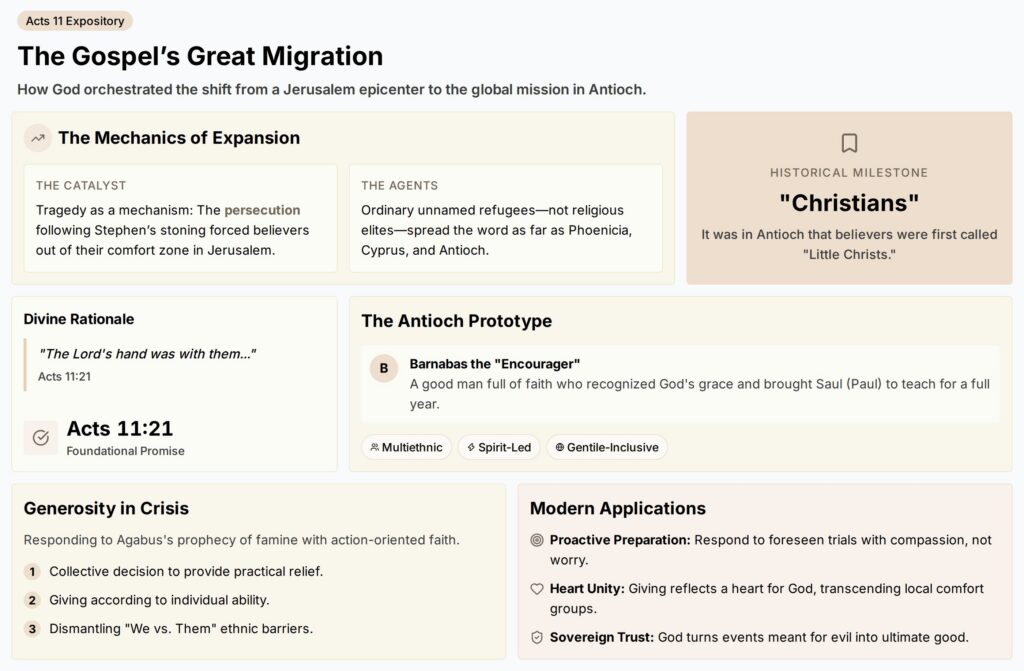
This sermon provides an expository teaching on Acts chapter 11, focusing on how God orchestrated the geographical and cultural expansion of the early church. It highlights the shift of the faith’s epicenter from Jerusalem to Antioch, emphasizing that this growth was propelled by persecution—specifically, the stoning of Stephen—and the obedience of ordinary believers. The core message is that God often uses trials and tragedy to accomplish His greater purposes, calling believers to trust and obey Him even in uncertain circumstances.
Peter’s Defense and the Principle of Obedience
This section recaps the previous lesson from Acts 11:1-18, where Peter defended his controversial fellowship with Gentiles—referred to as “those people”—before the leadership in Jerusalem. The pastor establishes the foundational principle that God is always at work, even in confusing or uncertain circumstances. We are reminded not to question God’s presence or care during such times but to remember the promise of Romans 8:28: that God works all things together for the good of those who love Him.
Peter’s interaction with Cornelius serves as a prime example of this principle. Both men acted in simple obedience to God’s direction without fully understanding the complete picture. Peter admitted he wasn’t sure why he was sent for, and Cornelius only knew he was told to send for him. When Peter recounted his experience to the initially critical Sanhedrin, their perspective shifted from opposition to celebration. This illustrates a core calling for believers: to listen, obey what God places on their hearts, share the truth of His work, and trust Him with the outcome, remembering that while some may plant and others may water, it is God who ensures the growth.
The Scattering and the Rise of Antioch
The sermon details the historical context for the church’s expansion, explaining that the persecution following Stephen’s martyrdom caused believers to scatter from Jerusalem. This scattering, while appearing as a tragedy, was the very mechanism God used to fulfill the commission of Acts 1:8 and spread the gospel to the “ends of the earth.” The pastor notes that God often uses tragedy as a catalyst for His work because, like the Israelites in the wilderness, people often remain stagnant until a crisis forces them to move.
Believers traveled as far as Phoenicia, Cyprus, and ultimately Antioch. Initially, they shared the gospel only among Jews. However, some men from Cyprus and Cyrene began speaking to Greeks in Antioch, a city of philosophers. This act marked the beginning of a significant shift, moving the epicenter of faith from the Jewish-centric community in Jerusalem to a new, Gentile-inclusive center. This expansion was not driven by religious elites but by ordinary, unnamed refugees who were obediently sharing what they had come to believe. It is a powerful reminder that God is sovereign and can turn events meant for evil into good for His purposes.
The Work of the Holy Spirit and the Birth of “Christians”
This section highlights the powerful ministry that unfolded in Antioch, where believers began preaching to Greeks for the first time. The pastor emphasizes that their success was not a result of their own eloquence or pedigree, but because, as Acts 11:21 states, “the Lord’s hand was with them,” leading a great number of people to believe. The movement was initiated by ordinary, unnamed refugees who took what they had heard and began sharing it.
When news of this reached Jerusalem, the church sent Barnabas, whose name means “encourager,” to assess the situation. Upon seeing the evidence of God’s grace at work, Barnabas was filled with joy and encouraged the new believers to remain true to the Lord. Described as a good man full of the Holy Spirit and faith, Barnabas then traveled to Tarsus to find Saul (Paul) and brought him back to Antioch. For a full year, they taught great numbers of people, and it was in Antioch that the believers were first called “Christians,” meaning “little Christs.” This church became the prototype for the New Testament: a diverse, multiethnic community bound not by cultural uniformity, but by a shared allegiance to Jesus Christ.
Generosity in the Face of Crisis
The sermon transitions to the church’s response to a prophecy from Agabus, who predicted a severe famine throughout the Roman world during the reign of Claudius. This historical event was also recorded by secular historians like Josephus. Instead of viewing the impending crisis in Judea as someone else’s problem, the diverse Gentile church in Antioch responded with immediate and practical generosity. They made a collective decision to provide help for their Jewish brothers and sisters, sending their gifts with Barnabas and Saul.
The pastor uses this as a model for true, action-oriented faith. The believers in Antioch did not offer mere well-wishes; they “rolled up their sleeves” and gave according to their ability. This act demonstrated that shared faith in Christ transcends deep-seated cultural, ethnic, and geographical barriers, dismantling any “we versus them” mentality. This compassionate and proactive preparation, alongside the example of Queen Helena—a wealthy convert who imported grain to feed the starving—illustrates that giving reflects a heart for God and unity. It is not the amount given but the heart behind the act that holds significance.
Concluding Principles for Modern Believers
This final section synthesizes the sermon’s lessons into actionable principles for contemporary Christians. The pastor emphasizes four key takeaways from the Antioch church’s example:
- True faith is action-oriented and generous, moving beyond words to provide tangible support.
- The global family of Christ supersedes local comfort groups, calling believers to look beyond their immediate circles and overcome a “we versus them” mentality.
- Preparedness should meet compassion, as believers should respond to foreseen trials not with worry, but with proactive preparation.
- Giving reflects a heart for God and unity, and it should be done cheerfully and according to one’s ability, not as a legalistic mandate.
The ultimate call is for believers today to see themselves as part of the ongoing story of Acts. Our role is to proclaim the gospel and trust that God is the one who does the work and brings the results. By trusting Him with all our hearts, especially during trials, and acknowledging His sovereignty, we can participate in His plan and ensure that He alone receives all the honor, glory, and praise.