
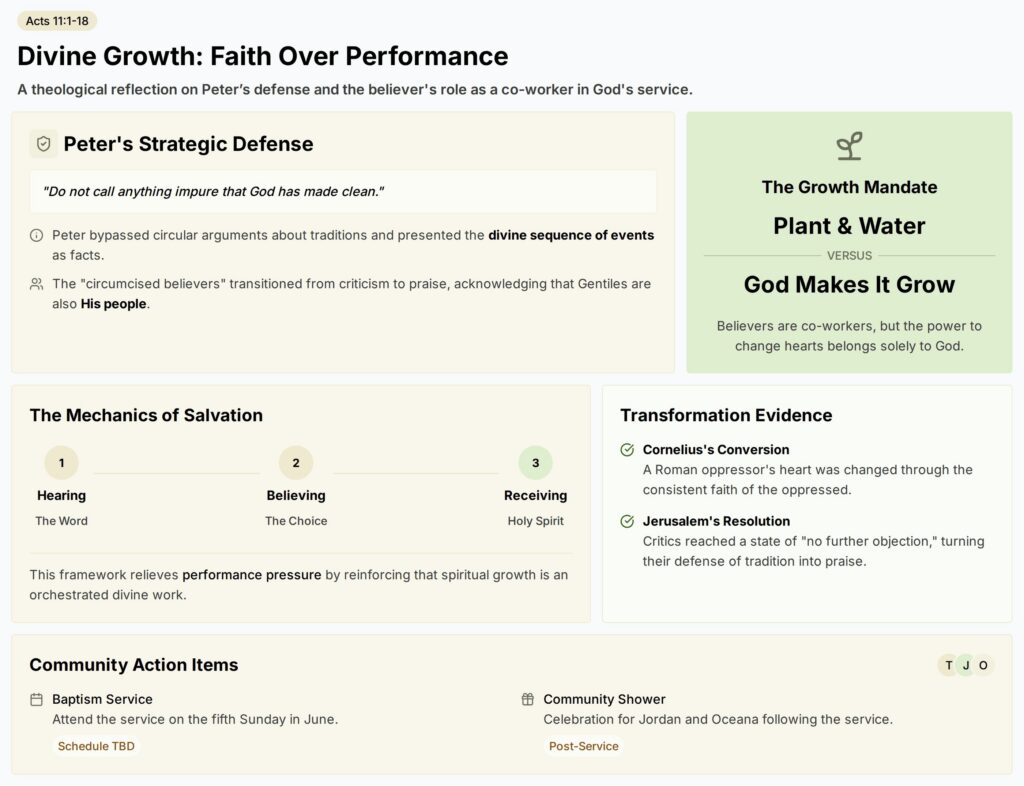
In a sermon analyzing Acts 11:1-18, the pastor examines Peter’s justification for sharing the gospel with the Gentiles and the eventual acceptance of this act by the Jerusalem leaders. The core message transitions to a broader theological principle: the believer’s role is to faithfully share the gospel by “planting and watering,” while the power to change hearts and “make it grow” belongs exclusively to God and the Holy Spirit. This perspective aims to relieve believers from the pressure of performance and the weariness of not seeing immediate results.
Peter’s Defense to the Jerusalem Leaders
This section covers the initial part of the sermon, which sets the context for Acts 11:1-18 by describing the controversy following Peter’s ministry to the Gentile, Cornelius. The pastor explains that upon hearing the gospel had spread to the Gentiles, the “circumcised believers” in Jerusalem—the original Jewish followers whom God had delivered from Egypt—did not celebrate. Instead, they criticized Peter specifically for violating their traditions by entering a Gentile’s home and eating with them. The pastor highlights this conflict between deeply ingrained cultural and religious norms and God’s expanding plan of salvation. He points out that the Jerusalem leaders, fixated on their traditions, nearly missed what God was doing. This tendency is likened to modern believers who can get caught up in their own familiar subgroups and historical backgrounds. The pastor also notes the timeless nature of the derogatory term “those people,” reminding the congregation that in God’s eyes, who is no respecter of persons, all individuals are “His people.”
The Recounting of God’s Divine Intervention
This section details Peter’s strategic response to the criticism from the Jerusalem leaders. Rather than engaging in a circular argument about Jewish customs, Peter chose to inform them of the essential facts by recounting the entire divine sequence of events. He described the vision he received in Joppa, where a large sheet from heaven presented him with animals considered unclean, and a voice commanded him three times, “Do not call anything impure that God has made clean.” Peter explained that the Holy Spirit then explicitly told him to accompany the men sent by Cornelius without hesitation. He brought six brothers as witnesses. Peter recounted that Cornelius, a Roman oppressor, had also received a vision from an angel, instructing him to send for Peter to hear a message of salvation for his entire household. The pastor notes that Cornelius’s own heart had been changed by witnessing the consistent faith of the very people he oppressed, illustrating how God can turn evil into good. Peter concluded his testimony by explaining that as he preached, the Holy Spirit descended upon the Gentiles just as He had upon the apostles at the beginning, confirming it was not his place to stand in God’s way.
The Resolution and the Role of the Holy Spirit in Conversion
This section focuses on the transformative outcome of Peter’s testimony and the central role of the Holy Spirit. After Peter recounted his experience, the Jerusalem leaders—previously described as ruthless in their defense of tradition—had “no further objection.” Their criticism turned to praise as they declared, “So then, even the Gentiles, God has granted repentance that leads to life.” The pastor emphasizes that this radical change of heart was not a result of Peter’s eloquence or persuasive power but was a direct work of the Holy Spirit. He asserts that this demonstrates a liberating truth: the work of changing hearts belongs solely to God, who can do “exceedingly more than we ever hope, dream, or imagine.” The narrative serves as a powerful illustration that true spiritual change is orchestrated by God, not engineered by human effort.
The Believer’s Role: Planting, Watering, and Trusting God for Growth
Transitioning from the biblical narrative to practical application, this section clarifies the believer’s role in evangelism. Drawing an analogy from 1 Corinthians, the pastor explains that believers are “co-workers in God’s service.” Like a farmer, one believer might “plant a seed” by sharing the gospel, while another might “water it” through encouragement and further discipleship. However, it is God alone who “makes it grow.” This theological principle is intended to relieve believers from the pressure of performance and the burden of feeling responsible for conversion. The primary job is to live out one’s faith authentically and share the good news without placing undue burdens on others. The pastor encourages the congregation not to become weary in doing good, trusting that even if results aren’t immediately visible, God is always at work and a harvest will be reaped in His proper time.
The Mechanics of Salvation: Hearing, Believing, and Receiving the Holy Spirit
This section synthesizes the sermon’s core theological message about the process of salvation into a clear, three-part formula observed throughout the book of Acts. First, a person must hear the message of truth—the gospel of salvation through the sacrificial death, burial, and resurrection of Jesus Christ. Second, the individual has the responsibility to choose to believe that message. Third, upon belief, the Holy Spirit completes the work of salvation, sealing the believer as a “deposit guaranteeing” their future redemption. This framework highlights the synergy between human responsibility (hearing and believing) and divine action (the transforming work of the Holy Spirit). The pastor reiterates that being “used by God” is not about personal gain but about being a humble, obedient, and surrendered vessel through which God works. This understanding liberates believers from the need for human eloquence, reinforcing that the power for spiritual growth rests with God.