
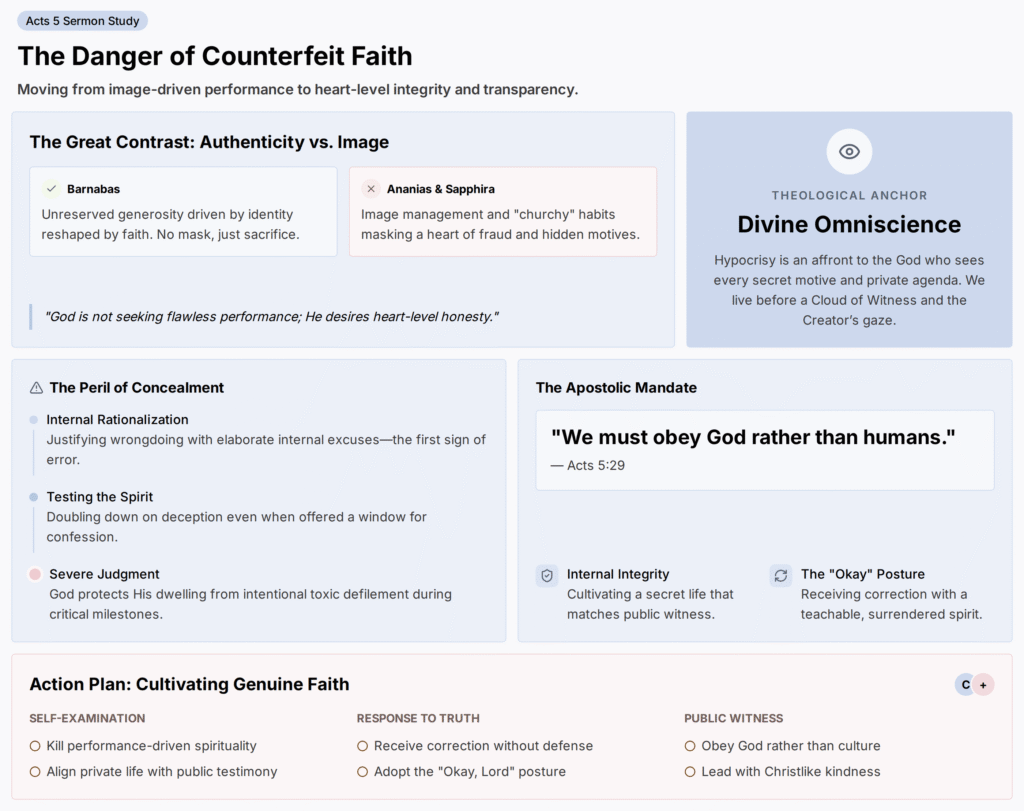
This sermon expounds Acts chapter 5 with sober clarity, using the account of Ananias and Sapphira to warn against counterfeit faith and image-driven spirituality. It contrasts their deception with Barnabas’s genuine generosity, stresses God’s omniscience and holiness alongside His grace, and calls believers to honest, teachable, and transparent discipleship marked by internal integrity and obedience to God over culture.
The Peril of Counterfeit Holiness
The pastor situates Acts chapter 5 as one of the New Testament’s weightiest passages, yet insists there is life in the text. The central thesis is that God is not seeking flawless performance; legalism imposes burdens humans cannot bear and demands what they cannot deliver. Instead, God desires sincerity and heart-level honesty, even as believers remember His holiness and refuse to license sin under grace. True holiness flows from surrender to and leading by the Holy Spirit—apart from Christ believers can do nothing, but in Him they have strength and hope.
Against the backdrop of Acts 4, the sermon recalls Barnabas’s unreserved generosity. As a Levite whose portion was in God, Barnabas sold his property and gave the proceeds, embodying identity reshaped by faith’s first principles. This authenticity drew attention, prompting others to covet perceived notoriety. The pastor connects this dynamic to contemporary image management: social pressure encourages polished appearances and avoidance of vulnerability, turning people into performers who mask reality. In Acts 5 the church’s honeymoon ends—unity hits a wall—and genuine relational strength must begin through honest engagement with strengths and weaknesses.
Ananias and Sapphira, seeking acclaim, sold property and conspired to present partial proceeds as total, with full knowledge between them. The issue was not retaining money—it was theirs, and no command required selling or giving everything—but the deliberate attempt to deceive. They could have honestly given half. The sermon labels their choice a hidden fraud, likening it to embezzlement and warning that rationalizing wrongdoing with elaborate justifications is a reliable sign of error. Old Testament parallels reinforce the point: Achan’s concealed devoted things (Joshua 7) drew God’s anger; Malachi 1:14 pronounces a curse on those who vow the best but substitute a blemished offering. The danger is engineering “counterfeit holiness” through churchy speech and habits that mask heart attitudes. God is not impressed by outward performance; He weighs the heart.
The Omniscience of God and the Deception of the Heart
Peter confronts Ananias’s lie as a direct offense against the Holy Spirit—an affront to God’s omniscience. The pastor underscores that omniscience means God knows all; therefore hypocrisy, secret motives, and private agendas are fully visible to Him. The call is to live with conscious, continuous awareness that God sees the heart completely.
This insight unfolds into the arena of spiritual warfare: believers must “take every thought captive” and make it obedient to Christ. Thought-life matters because as a person thinks, so they live. Paul’s teachings are referenced: the Ephesians are reminded the real battle is not against flesh and blood (Ephesians 6), and the Romans passage confesses the internal struggle to do what is right and refrain from what is wrong. The sermon insists that the world’s cynicism often searches for reasons not to believe; the hypocrisy of believers can be the most persuasive reason to dismiss the church. Therefore, the integrity of believers’ inner lives must shape their outward behavior, becoming the witness that displays the power of God to the watching world.
Divine Judgment and Critical Milestones
When Ananias hears Peter’s words, he falls down dead, and great fear grips all who hear. Young men wrap his body, carry him out, and bury him. The pastor frames this severe judgment within the flow of redemptive milestones from Genesis to Revelation: the Exodus and entry toward the promised land; the judges and prophets who foreshadowed; the birth, ministry, death, burial, and resurrection of Jesus; the outpouring of the Holy Spirit establishing the New Testament church; and the ongoing spread of the church “to the ends of the earth.” In such critical moments, God’s holiness brooks no compromise that might disrupt His purposes. The pastor cites Leviticus 10—Aaron’s sons offering unauthorized fire and being consumed—as a historical counterpart that warns God will protect His dwelling (now the church) from intentional toxic defilement.
This theological frame continues: the next milestones include the return of Christ and the rapture of the church, a seven-year tribulation, and the ultimate return of Christ to inaugurate a new heaven and new earth. Though believers live in a season of grace upon the church, God still calls them to holiness. The practical counsel is vigilance: since the day and hour are unknown, believers must make the most of every opportunity daily and refuse “nonsense”—knowing what to do but doing the opposite. The sermon quotes Hebrews 10:31 to reinforce a healthy fear of God, warning that believing one has “gotten away with” wrongdoing cultivates a destructive lifestyle. It is better to be caught and corrected early than to persist and incur compounded consequences.
About three hours after Ananias’s death, Sapphira arrives unaware of events. Peter asks whether the amount presented was the full price; she confirms it and thus tests the Spirit of the Lord. Although offered an implicit off-ramp to tell the truth, she doubles down on the lie. Peter declares the same fate: she falls dead, and the young men bury her beside her husband. The sermon highlights Deuteronomy 6:16—do not test the Lord as at Massa—recounting Israel’s post-Red Sea complaints about hunger and thirst, their forgetfulness of deliverance, and their slide from disobedience into rebellion. Concealing sin does not prosper (Proverbs 28). The distinction is critical: disobedience neglects a command; rebellion defies it. Cornered in compromise, humans instinctively “lie harder,” but that path is ruinous.
The Opportunity for Repentance and the Path to Authenticity
Turning from judgment to mercy, the pastor portrays every pointed question, sermon, tension, and unease as a gracious window to drop masks and receive healing. Personal reflection admits that during seasons of wrongdoing, the instinct is to avoid Scripture and prayer—yet transformation rests on hiding God’s word in the heart so it can caution and correct. A healthy fear of the Lord recognizes how habitual sin becomes a slippery slope.
The practical invitation is simple but demanding: listen and receive correction instead of doubling down in self-defense. Be teachable; let go of pride. The liberating practice is to respond with “okay” when confronted by truth—an “Okay, Lord, okay” posture that trusts His sufficient grace. The sermon closes the loop by reiterating: God seeks honesty, not image management. He knows human imperfection and sees hypocrisy clearly. His patience is not permission. Internal integrity precedes external impact; what is cultivated in secret will govern public witness.
Practical Application: Living a Genuine Faith
The narrative of Acts 5 continues with the church’s growth: extraordinary signs and wonders occur at Solomon’s colonnade, even Peter’s shadow brings healing. The high priest arrests the apostles, an angel delivers them, and despite re-arrest and flogging—acknowledged as severely painful—the apostles insist, “We must obey God rather than humans.” They rejoice at being counted worthy to suffer for Jesus’s name.
The sermon distills action-oriented directives for believers:
- Kill performance-driven spirituality. Be real and authentic; let the private life match the public testimony.
- Obey God rather than culture, reframing personal friction or insult as a badge of honor akin to the first century church’s perspective, rejoicing in bearing Jesus’s name in a broken world.
- Walk transparently, lead with Christlike kindness, and entrust outcomes to the sovereign Lord instead of playing games with Him or fearing a hostile world.