
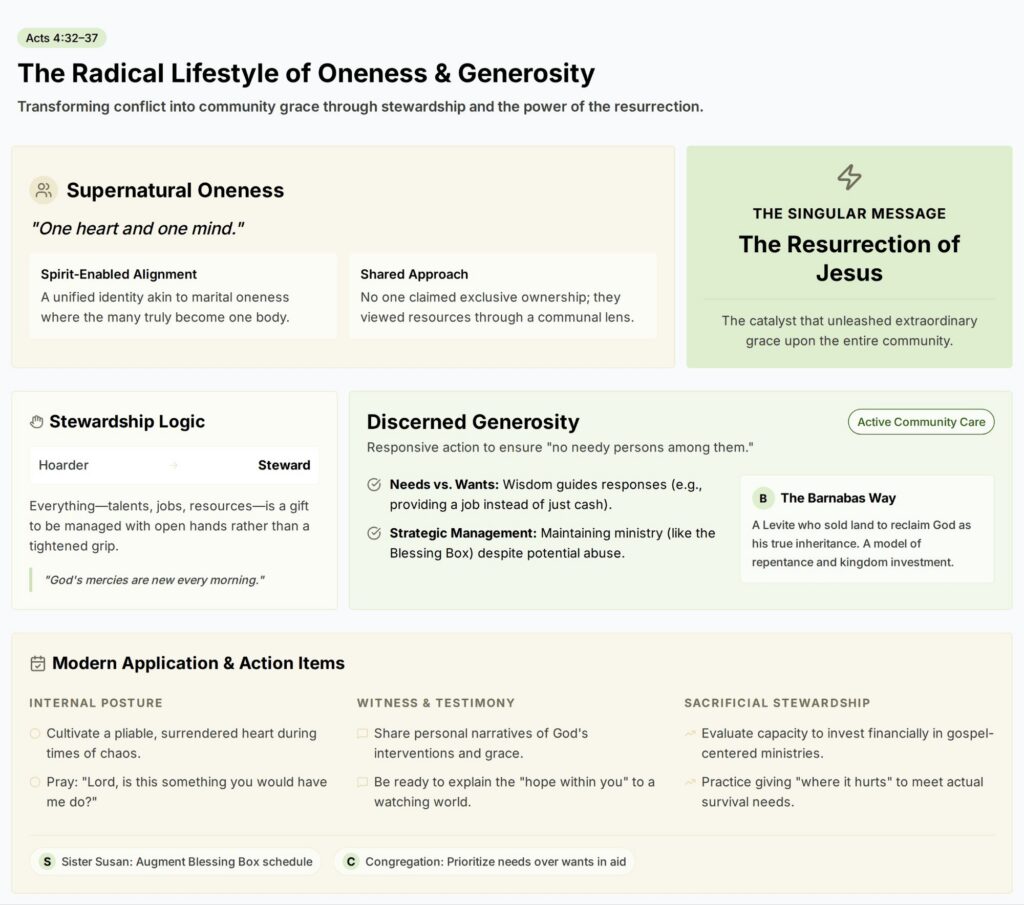
This sermon on Acts 4:32–37 presents how God uses conflict to advance His purposes and how the early church’s unity, stewardship, and focus on the resurrection unleashed extraordinary grace. It calls modern believers to cultivate a pliable, surrendered heart, practice discerning generosity, and boldly witness through personal testimony, with practical steps for community care and ministry support.
God’s Use of Conflict and the Call to Trust
The speaker frames the message within an ongoing journey through the Book of Acts, highlighting the birth and formation of the New Testament church. He emphasizes a recurring biblical pattern: conflict followed by a faithful response that turns the community’s gaze from horizontal fear to vertical praise. Drawing from the crucifixion and resurrection, he asserts that what is meant for evil, God turns for good, culminating in a pathway to both present life and eternal life. He cites Jesus’ words in John about inevitable trials and James’ call to count them as joy, urging a trust that is wholehearted rather than merely intellectual.
The sermon warns that intellectual pride hardened the hearts of some Jewish leaders, blinding them to the Messiah despite diligent study. In contrast, believers are exhorted to maintain a pliable, humble heart, especially in chaos when surrender is most costly and most necessary. The sovereignty of God—His control over every circumstance and trial—is presented as the bedrock of confidence: while situations may exceed human strength, they never exceed His. The speaker advocates adopting the early church’s mindset in congregational life, households, and workplaces, noting that the Holy Spirit often works through obedience in inconvenient circumstances.
The Oneness and Generosity of the Early Believers
Turning to Acts 4:32, the sermon underscores the community’s supernatural unity—“one heart and mind”—and their shared approach to possessions: no one claimed exclusive ownership; they shared everything. This unity is portrayed as a Spirit-enabled alignment where the many become one, akin to marital oneness and the unified identity of a family recognized by one name. The church is described as the body of Christ, called to display oneness to a watching world hungry for hope.
Stewardship is central: everything—talents, resources, jobs, opened doors—is presented as God’s gift. Believers are stewards, not hoarders, opening their hands rather than tightening their grip. In contrast to the “heavy hand” of the Sanhedrin, the apostles’ and Jesus’ “healing hand” reflects God’s generous character, whose mercies are new every morning. The world is in need of such healing and generous hands, and the church’s unified, selfless posture becomes fertile ground for the Holy Spirit’s extraordinary work.
The Centrality of the Resurrection and God’s Grace
The sermon clarifies that the apostles’ proclamation was not prosperity teaching. Their singular message was the resurrection of the Lord Jesus, and God responded by pouring out grace powerfully on the entire community. The speaker invites recognition of God’s unmerited favor, contrasting divine generosity with human rationalizations that often stifle compassion.
He shares a personal episode: seeing a distressed woman by her van needing help, then driving away after mentally debating reasons not to engage. That missed opportunity remains a poignant reminder to let the Holy Spirit’s prompt be the first response—“Lord, is this something you would have for me to do?” He expresses gratitude that God does not scrutinize our deservingness when extending mercy and provision, referencing Romans that all have fallen short and that Christ died for sinners. While this does not prescribe indiscriminate handouts, it calls for sensitivity to Spirit-led guidance and readiness to act when prompted.
The Practice of Meeting Needs and the Example of Barnabas
The practical aim in Acts 4 is that “there would be no needy persons among them.” From time to time—underscoring that generosity was responsive, not constant—believers sold land or houses, brought proceeds to the apostles’ feet, and funds were distributed to anyone in need. The speaker acknowledges modern complexities in charity, describing a “blessing box” managed by Sister Susan. While some genuinely need help, others strategically clear the box immediately after stocking. Rather than shutting down the ministry due to abuse, the sermon advocates wise management—adjusting stocking times, clarifying purpose, and trusting God’s justice—while maintaining the commitment to meet true needs, as God desires that none go without.
The sermon highlights Joseph, called Barnabas (“son of encouragement”), a Levite from Cyprus, who sold a field and laid the money at the apostles’ feet. This detail is deemed significant: according to Numbers, Levites’ inheritance was God Himself, not land. Barnabas owning land suggests a drift from Levite distinctiveness toward ordinary material possession. His sale and offering signal a turning back—repentance—to embrace God as true inheritance. As an outsider from Cyprus, his participation also signifies the gospel’s expansion beyond local confines (Jerusalem, the Roman milieu, and Sanhedrin pressures) toward the “ends of the earth.” This moment exemplifies how discerned generosity, rooted in repentance and stewardship, advances the kingdom’s reach.
Application for the Modern Believer
The sermon calls believers to a radical communal lifestyle: unwavering faith in Christ’s resurrection, a vertical perspective anchored in hope rather than fear, and boldness in the name of Jesus despite opposition. It encourages an immense sense of freedom and gratitude in knowing God and urges reliance on personal testimony—a lived, clear narrative of God’s interventions—as a powerful witness, even for those not theologically trained or quick to recall Scripture under pressure. Believers should be ready to give an answer for the hope within them, knowing they are dearly loved by God, and demonstrate discipleship through mutual love.
Practically, the community is exhorted to evaluate capacities and opportunities, invest financially and materially in ministries that glorify God, and sometimes give sacrificially—“where it hurts.” In discerning generosity, the sermon emphasizes meeting needs rather than wants: if someone seeks money but needs a job, or wants cash but needs food, wisdom and discernment should guide the response. The closing prayer asks God to shape grateful hearts, remind the church of His ownership of all things, train them in needs-based generosity, and preserve unity of heart and mind in giving glory to Jesus Christ.