
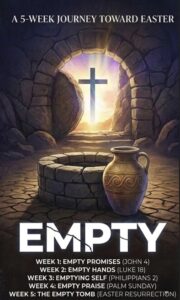
Summary The sermon delivered by Pastor Page on March 8, 2026, focuses on “emptiness” and how only God can truly fill the inner void in human life. Using John 4 (Jesus’ encounter with the Samaritan woman at Jacob’s well) as the core text, the pastor highlights divine appointments, the insufficiency of temporary solutions, and the transformative “living water” Jesus offers, which becomes a spring welling up to eternal life.
The message connects contemporary geopolitical tensions in the Middle East to biblical prophecy (Ezekiel 38), encourages believers to remain grounded in Scripture, and calls for countercultural grace that crosses social, moral, and geographic boundaries.
It concludes with practical exhortations: listen empathetically, be ready for inconvenient detours that may be divine appointments, live a surrendered life, and witness authentically to the hope found in Christ. Key Points
- Emptiness and Divine Appointments Emptiness in Human Life
- God created an inner place only He can fill; humans often try to fill this void with temporary substitutes (vacations, routines, rituals, full schedules) that cannot provide lasting satisfaction.
- Emptiness shows up as weariness, lack of joy, and busyness trapped in repeated patterns that do not meet deeper needs, reflecting the fall’s “scarcity mindset” (me, myself, and I). Divine Appointments and Inconvenience
- Jesus “had to go through Samaria” not because it was the direct route but as an intentional detour to meet the Samaritan woman, illustrating that divine encounters often require going out of one’s way.
- Believers should expect detours and inconveniences as contexts for divine appointments in which they may represent Christ or be encountered by Him.
- The Samaritan Woman at the Well (John 4:1–24) Context and Cultural Barriers
- Jesus leaves Judea for Galilee, sits at Jacob’s well in Sychar at noon (verses 1–6).
- Samaritans were despised by Jews (considered “dogs” and “less than”); as a Samaritan woman without a husband, she was “less than less than,” socially marginalized.
- Jesus crosses geographic (Samaria), social (Jew–Samaritan), and moral boundaries to engage her, demonstrating countercultural grace. Living Water vs. Stagnant Wells
- The woman draws from a limited, stagnant source daily; Jesus offers “living water” that continuously satisfies and becomes “a spring of water…welling up to eternal life” (verses 10–14).
- The living water symbolizes life, movement, freshness, audibility/visibility, nourishment, and transformative impact on its surroundings—eternal in nature. Misconceptions and Resource Mindset
- The woman questions Jesus’ capacity, noting He has no bucket and the well is deep, reflecting a human tendency to judge solutions by visible resources and familiar methods.
- God’s methods differ from human methods (“my ways aren’t your ways”), and help may arrive in unexpected forms that do not mirror our resource expectations. Personal Need and Truthfulness
- Jesus identifies her core pain point: “You have had five husbands, and the man you now have is not your husband” (verses 16–18). The focus is not blame but healing the area affecting identity and worth.
- The Word of God is “living and active…nothing…is hidden from God’s sight” (Hebrews 4:12–13), so Scripture should be used for development and discernment, not self-justification. True Worship
- Jesus teaches that a time is coming when worship will not be tied to specific mountains or Jerusalem; true worshipers will worship the Father in spirit and truth (verses 21–24).
- “Salvation is from the Jews,” underscoring Israel’s role in God’s redemptive plan and connecting to broader eschatological themes.
- Theological Foundations and Eschatology God’s Knowledge and Love
- God loves and sees individuals intimately (Psalm 139:3: “You discern my going out and my lying down; you are familiar with all my ways”), providing comfort and a humbling awareness of His familiarity with our habitual patterns. Grace, Sufficiency, and Surrender
- God’s grace is sufficient (Paul’s teaching), and believers should depend on Christ for strength (“I can do all things through Christ who gives me strength”), living a surrendered life because human effort alone is inadequate (“we don’t have the bucket”).
- “Christ in us is the hope of glory,” calling believers to let Christ do through them what they cannot do themselves; Christians are called to be like Christ, reflecting His identity. Middle East Context and Prophecy
- Current challenges in the Middle East are described as “stage setting” rather than the end itself, pointing to preparation for the second coming of Christ, with no one knowing the day or hour.
- Ezekiel 38 is cited: Persia (modern-day Iran) attacks Jerusalem, supported by what is now modern-day Russia—biblical patterns aligning with present geopolitical tensions.
- Israel’s ongoing significance: Jews as God’s chosen people, others grafted into the promise; the Exodus, wilderness, Red Sea crossing, Promised Land, and tribes underscore Israel’s centrality. Readiness and Discernment
- Believers should study the Word to “rightly divide” and understand the times in relation to God’s work, not merely human actions; keep lamps “trimmed and burning” in anticipation of the Lord’s inevitable return.
- Seek God’s perspective for tasks, allowing Him to strengthen for the assignments He gives, rather than self-defined tasks.
- Practical Discipleship and Witness Listening and Engagement
- Engage in conversations with those typically overlooked or avoided; offer a listening ear as Jesus did. He allowed the woman to speak and responded in a way that led to deliverance. Witness and Transformation
- The Samaritan woman becomes a witness—she returns to the village and tells everyone, “Come see the man…who knew everything about me,” leading to communal impact from one encounter.
- Even though physical routines remain (she still draws water), spiritual satisfaction transforms purpose: she now has living water and becomes nourishment to others. Countercultural Grace and Unity
- Jesus breaks down racial, social, and political divisions, dissolving “us vs. them” mindsets; He is a unifier, bringing disparate groups together. Shepherd Imagery and Assurance
- Jesus is the Good Shepherd who leaves the ninety-nine for the one; those feeling lost should be still and listen for the Shepherd’s voice—He comes to deliver, not to blame.
- Assurance: We are fully known; Jesus chooses to engage with our true needs, seeking transparency and honesty, revealing His identity to those who are real with Him.
- Pastoral Reflections and Application Ministry Preparedness and Life Pressures
- The pastor shares personal stress in sermon preparation due to competing responsibilities, emphasizing the commitment to be prepared and grounded in God’s Word. Empty Promises in Relationships
- The woman’s relational history may reflect a series of empty promises; believers often feel disenchanted when desired answers don’t appear as hoped. God can step into ordinary routines to offer a different perspective. Sensitivity to Divine Setups
- Inconvenient situations or distractions may be divine appointments prepared for kingdom purposes (“Thy kingdom come, Thy will be done on earth as it is in heaven”).
- Believers should be sensitive to out-of-the-way encounters, especially with culturally different or overlooked individuals, seizing opportunities to speak hope and give an answer for the hope within.
Assignments
- Read John 4:1–24 in full and reflect on the contrast between stagnant water and living water; identify areas in your life where you rely on temporary wells.
- Study Ezekiel 38 and note references to Persia (Iran) and allied forces (modern-day Russia); consider how current events might be “stage setting” rather than definitive end times.
- Memorize Psalm 139:3 and Philippians 4:13; journal how God’s familiarity with your ways and Christ’s strength reshape your daily responsibilities.
- Identify “your Samaria”: a person or group you typically avoid. Plan and carry out one intentional, listening conversation this week, offering grace without prejudice.
- Examine a recurring routine that feels empty; ask God for a “living water” perspective and note any inconvenient detours that might be divine appointments.
- Prepare to “give an answer for the hope within” by writing a brief personal testimony emphasizing Christ’s work in you rather than your own efforts.
- Keep spiritual “lamps trimmed and burning” by setting a daily Scripture study schedule aimed at discerning God’s work in current times, not merely tracking human actions.